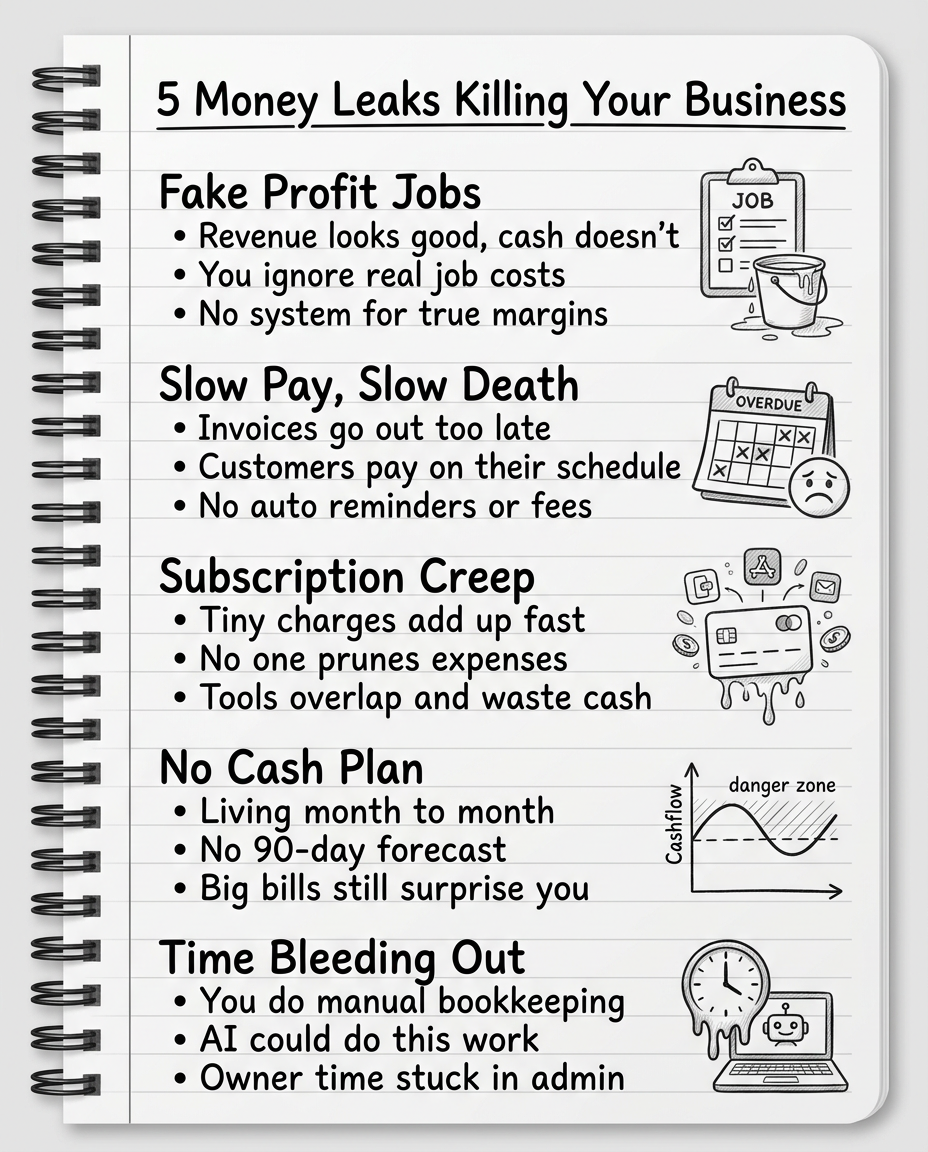
If you've ever looked at your bank app and thought, “Where did it all go?”, this is for you. You're not lazy, and you're not dumb. You just have invisible holes in your bucket.
Poor cash flow, not lack of ideas, is the main reason otherwise solid small businesses shut down. In this post I'm going to walk you through five specific money leaks that quietly bleed cash out of your business every week. You'll recognize your situation in at least one of them. Then I'll show you how to plug each leak with simple systems.
You're already in motion — customers, jobs, invoices. Now the game is turning chaos into control so the money you're working for actually stays in your business.
Leak #1: “Profitable” Jobs That Still Leave You Broke
On paper, the job looked great. You charged $10k. Materials were $4k. Labor was $3k. Boom — $3k profit, right?
Except you forgot:
- • Gas to drive to the site
- • The extra run to Home Depot because the original order was short
- • The 10 hours of “unpaid” quoting, follow-ups, and scope changes
- • The 3% card processing fee on the invoice
By the time it all shakes out, that juicy “$3k profit” is more like $900 — and you don't see that until weeks later because you're not tracking it in real time.
This happens across industries. Contractors underprice jobs. Agencies throw in extra revisions. Local shops discount too often. Everyone thinks “we're making money,” but the business is running on fumes because decisions are made off revenue and gut feel, not true job profitability.
How to plug this leak
Track everything per job or client — materials, labor (including your own time), subs, travel, and fees.
Force a post-job profit check. After each project, review: invoiced amount, all costs attached, true margin. Anything that surprises you goes on a “never again” list with a note on exactly what went wrong.
Systemize the math. A tool like CogniFlow Books lets you attach costs, labor, and invoices to each job automatically so real profitability is calculated for you — no spreadsheet required.
When you start seeing which jobs actually pay you and which ones don't, you stop saying yes to work that looks good and start saying yes to work that is good.
Leak #2: Slow-Paying Customers and Broken Invoicing
You delivered the work. You sent the invoice. Now you're refreshing your banking app wondering why nothing is happening.
Cash flow problems are often not about how much you bill — but how fast it comes back. Common patterns:
- • You invoice late because you're “too busy” on the next job
- • Payment terms are vague or overly generous (NET 30 turns into NET whenever)
- • You don't send automatic reminders — you just wait and quietly resent them
- • You let customers stack up big balances with no structure, then get surprised when they ghost
You're acting like a bank — fronting time, materials, and effort — without any of the protections or systems an actual bank uses.
How to plug this leak
Tighten your payment structure. For projects: deposit (20–50%), progress payments, and a final payment before handoff. For recurring work: auto-bill at the start of the period, not the end.
Invoice immediately. No “I'll do it Friday.” Make it a rule: invoice the same day a milestone is hit.
Automate reminders and late fees. Reminders at 3 days before due, day of, 3 days after, 7 days after — and mean the late fees you write in.
Make paying stupidly easy. Payment links in the invoice, multiple methods (card, ACH, Zelle), clear instructions. CogniFlow Books can generate invoices directly from jobs, send on schedule, and automatically follow up so cash comes in faster without you manually chasing every dollar.
When cash in and cash out are timed correctly, you feel the difference immediately. You're no longer juggling survival between paydays — you're running the calendar on your terms.
Leak #3: Subscription Creep and “Tiny” Expenses
Most owners obsess over big line items — payroll, rent, materials — and ignore the slow drip of “small” charges that quietly stack up.
- • Extra SaaS tools you forgot you had
- • “Free trial” that turned into $49/month
- • Software seats you're paying for but no one uses
- • Services you signed up for in the early hustle that you never cancelled
Individually, they don't look like much. But recurring small expenses compound into thousands per year if you don't actively monitor them — because no one is responsible for pruning the list, so it grows wild.
How to plug this leak
Pull a 90-day expense download. Export all bank/card transactions and highlight anything that recurs or you don't instantly recognize.
Tag every recurring charge as Must Keep, Nice to Have, or Dead Weight. Cancel dead weight immediately. Look for overlap — three tools doing similar things. Negotiate or downgrade nice-to-haves.
Create an owner review rhythm. Once per quarter, schedule a 30-minute “expense pruning” session. This is not optional. In CogniFlow Books, expenses are categorized automatically and you can see trends by vendor over time — making waste obvious.
Trimming $200–500/month in dead tools doesn't just save money — it gives you more room to pay yourself, upgrade key hires, or invest in marketing that actually grows revenue.
Leak #4: No Cash Flow Plan — Only Hope
You might be profitable this month and still hit a wall in 90 days. Why? Because profit and cash timing are not the same thing.
Here's the pattern:
- • You land a few big jobs and feel rich
- • You upgrade gear, maybe sign a lease, maybe hire
- • Supplier bills come due. Payroll hits. Tax estimates land.
- • Customers pay late, or a couple of deals slip
- • Suddenly you're moving money between accounts asking, “How did this spin out this fast?”
You didn't plan cash. You just reacted. You're running the business like a month-to-month gig, not like a machine with predictable inflows and outflows.
How to plug this leak
Build a simple 90-day cash forecast. You don't need a Wall Street model. You need: expected revenue by month, fixed costs (rent, software, insurance, payroll), variable costs, and tax estimates / big irregular hits.
Stress test it. “What if revenue is 20% lower?” “What if customers pay 30 days late instead of 7?” If the model shows you hitting zero, adjust now — before reality does.
Set a minimum cash runway. Decide what your “panic line” is (one month of expenses, two payrolls). Build toward holding that buffer. CogniFlow Books already understands your jobs, invoices, and expenses — so forecasting is grounded in real numbers, not memory.
With a clear forward view, you stop making big decisions based on today's checking balance and start making them based on what the next 3–6 months actually look like.
Leak #5: Your Time Is Bleeding Out on Low-Value Work
If you're still manually entering receipts, categorizing every transaction yourself, copy-pasting numbers from your bank into spreadsheets, or building invoices from scratch every time — you're leaking your most valuable resource: attention.
Owner time value (sales, strategy, better clients) = $100/hr
Hours/week spent on admin and bookkeeping = 5–10 hrs
= $500–$1,000/week opportunity cost that never shows on your P&L
“I'll just do it myself” feels frugal. It's actually one of the most expensive habits in your business.
How to plug this leak
List every repetitive money/ops task you do. For one week, write down every admin/accounting task and how long it took: invoicing, chasing payments, entering receipts, reconciling accounts, updating spreadsheets.
Circle everything that doesn't require your judgment — reading receipts, categorizing typical expenses, matching bank transactions, sending standard reminders.
Delegate to AI and systems first, humans second. Solutions like CogniFlow Books are built specifically for contractors and service businesses: read and categorize receipts, auto-reconcile accounts, generate financial reports in real time, alert you to weird charges. Your books stay clean day-to-day instead of “whenever you have time.”
Reinvest your freed time into higher-quality clients, new offers, training your team, or building systems that remove you from daily fires. The owners who win over the next decade will treat AI and automation like force multipliers — not gimmicks.
This Week: Exactly What You Should Do Next
Reading about money leaks doesn't fix them. Plugging them does.
Audit one recent job or month in detail
List all revenue tied to it, all costs (including your time), and calculate the true margin. If you're surprised by how little was left — you just found a leak.
Map your receivables and terms
List everyone who owes you money right now and how long they've owed it. Decide: what will you change next invoice cycle? Deposits, earlier invoicing, automated reminders?
Kill at least three recurring charges
Pull a 90-day expense list. Cancel or downgrade at least three subscriptions that are not truly critical. Put a 30-minute expense review on your calendar for 90 days from now.
Sketch a simple 90-day cash view
Rough out expected revenue, fixed costs, and major variable costs for the next 3 months. Identify any month where the math looks tight and decide what you'll adjust now.
Choose one area to systemize with AI
Invoicing and reminders, expense tracking, job profitability tracking, or monthly reporting. Commit to getting at least one money process out of your manual headspace and into an automated system this month.
You don't have to fix everything at once. But if you plug even one of these leaks, you'll feel it — more money staying in the business, less anxiety when you open your banking app, and more bandwidth to actually build the thing you started this business for.
Plug Every Leak With CogniFlow Books
Job costing, automated invoicing, expense tracking, cash flow forecasting, and AI-powered bookkeeping — all in one platform built for contractors and service businesses. Try it free for 7 days.
Start Free Trial