Small businesses regularly get crushed by cash flow issues, shrinking margins, and accounting mistakes even while work keeps coming in — and poor pricing sits right in the middle of that mess.
You can be great at what you do, deliver real value, and still undercharge so badly that your business slowly chokes on its own growth. A lot of owners price based on fear, guesswork, or what they think the market will tolerate. They copy competitors, throw on a markup, and hope the math works later. The problem is that cost pressures, wages, software, support time, payment fees, and rework all keep moving — so simplistic pricing formulas get stale fast.
Let's fix that. Here are five pricing mistakes that quietly kill margin, why they happen, and what to do this week so you stop winning work that makes you poorer.
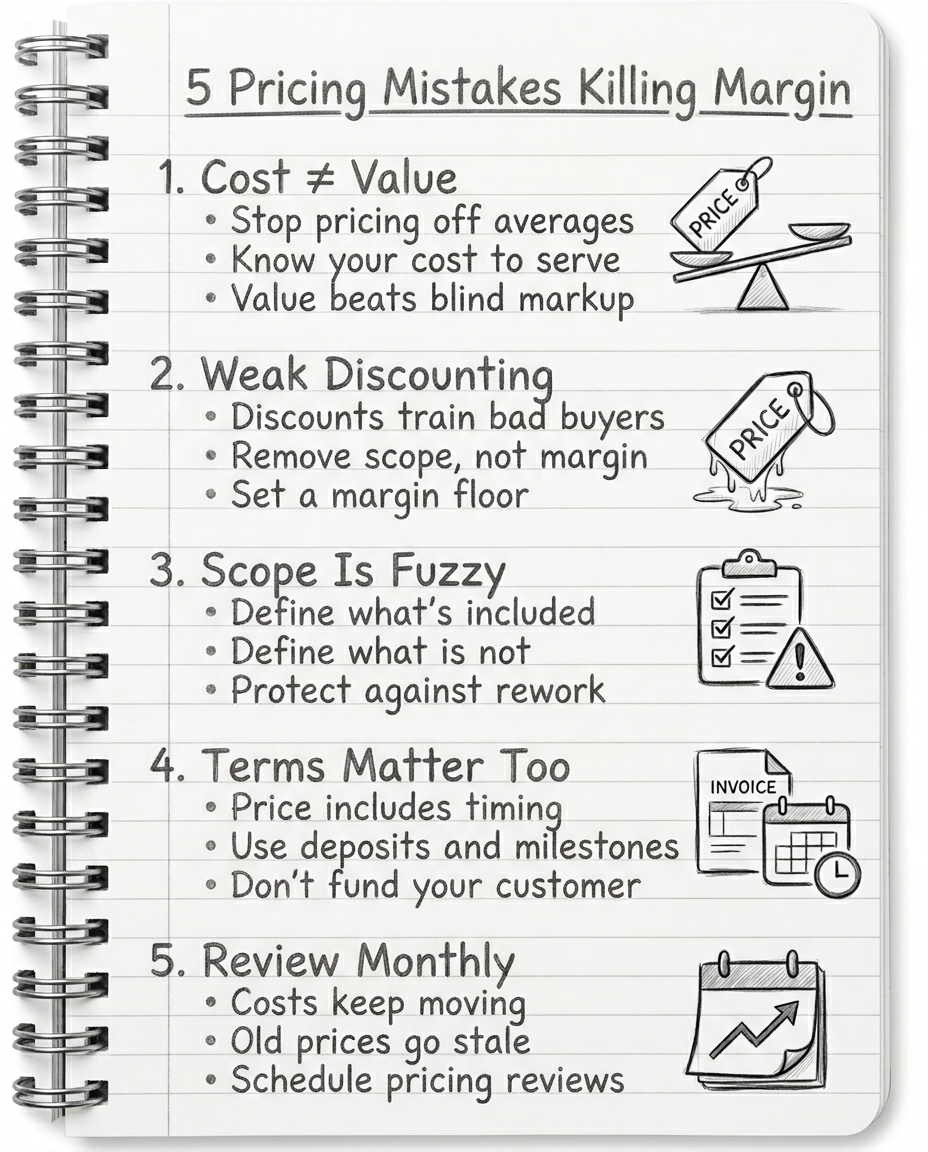
Mistake #1: You're Pricing Off Cost, Not Value
A lot of owners start with a basic formula: cost + markup = price. That sounds reasonable. It also fails all the time.
Why? Because average costs hide real variation. One customer is easy. Another needs 14 emails, two site visits, three revisions, a rush timeline, special handling, and extra support after the job is done. On paper, both sales look similar. In reality, one is clean profit and the other barely breaks even.
If you only price around hard cost — materials, labor, software seat — you ignore the full cost to serve: coordination, communication, revisions, overhead, follow-up, payment friction, and all the admin nobody remembers when quoting. That's how a job looks profitable in a spreadsheet but feels terrible in real life.
What this looks like across industries:
- • A contractor prices the install but forgets the change-order chaos, material runs, and callback time
- • A service business sells a monthly package but eats unlimited support because the client is high-maintenance
- • A local business offers delivery or rush service without charging enough to cover the strain
- • An agency includes strategy, edits, and hand-holding in the base price because saying no feels uncomfortable
The fix: build at least three pricing buckets
Standard work — predictable delivery, low coordination
Custom or high-touch work — more coordination, more back-and-forth
Premium or urgent work — faster timelines, more access, more complexity
Stop pretending every customer is the same. CogniFlow Books is built around job estimates, payment schedules, price checks, and profitability tracking — so you can see whether the work you're selling is actually worth doing instead of guessing off top-line revenue.
Mistake #2: You're Discounting Because You Don't Trust Your Offer
Discounting feels like a sales tactic. Most of the time it's a confidence problem. When an owner discounts too fast, it usually means one of three things:
- • You don't know your numbers well enough to defend your price
- • You don't know your value clearly enough to explain it
- • You're scared to lose the deal, so you trade margin for emotional relief
The bigger issue is what discounting teaches your customers: it trains them to negotiate before they buy, tells them your first number wasn't real, and makes price the center of the relationship instead of outcome, trust, or expertise. That's how owners get trapped in low-margin, high-maintenance client bases — winning people who are price-sensitive but not loyal to results.
You need rules — not vague intentions
- • No discounting without removing scope
- • No discounting without changing payment terms
- • No discounting below target margin
- • No custom quote leaves without a minimum acceptable gross margin
- • No “friend/family” pricing unless it's accounted for intentionally
Better scripts to use instead:
- → “If budget is the issue, we can reduce scope.”
- → “If you want the lower price, we can remove X, Y, and Z.”
- → “If you want faster delivery, the premium stays.”
CogniFlow Books includes a Price Check tool and margin visibility built around the work itself — exactly the kind of operational backstop that helps you stop quoting emotionally.
Mistake #3: You're Selling Work Before You Define the Scope
A lot of pricing problems are actually scope problems wearing a money costume. If your estimate or proposal is vague, your customer and your business are imagining two different deals. That gap becomes unpaid work, rework, delays, and margin loss.
This is especially brutal for contractors, agencies, and any business where the final outcome depends on details. If scope is fuzzy, the customer fills in the blanks with whatever they think should be included. And guess who eats the cost when expectations don't match reality? You do.
Stop thinking of a quote as a number — treat it as a boundary document
Every strong quote does four things:
- • Tells the customer what they get
- • Tells the customer what they do not get
- • Protects your labor and attention
- • Creates a cleaner path from sale to payment
Your quote should always include: clear scope, clear exclusions, clear timeline, clear payment schedule, clear assumptions, and a clear change-order process. CogniFlow Books' AI-assisted SOW and estimate workflow turns a simple job description into a professional scope of work, line items, and pricing logic — which helps eliminate the “I thought that was included” problem before it starts.
When you skip scope clarity, you don't just lose money — you create chaos in operations. Sales overpromises, delivery scrambles, and the owner ends up making judgment calls in the middle of the job. That's not scale. That's improvisation.
Mistake #4: You're Ignoring Payment Terms as Part of Pricing
Most owners think price is the number on the quote. It's not. Price includes when and how you get paid.
A $10,000 deal paid upfront is not the same as a $10,000 deal paid 45 days late. A monthly retainer on autopay is not the same as chasing invoices manually. A project with a deposit and milestone payments is not the same as floating the whole job until completion.
When you price without thinking about payment structure, you often underprice the deal even if the number looks fine. Payment timing, settlement, and fees all affect real cash flow — not just theoretical revenue. Ignore that and you end up funding your customer's convenience with your own working capital.
What better payment discipline looks like
- • Deposit before work starts
- • Progress billing for longer projects
- • Autopay for recurring services
- • Faster payment incentives when useful
- • Late fee language enforced — not just written
- • No delivery or final handoff before critical payment milestones
CogniFlow Books is built around estimates, invoices, deposits, progress billing, accounts receivable, and aging reports — exactly the operational layer that makes payment terms enforceable rather than theoretical.
If you want higher-quality cash flow, stop treating payment terms like a small note at the bottom of the proposal. They are part of the offer itself.
Mistake #5: You're Not Reviewing Pricing Often Enough
A lot of businesses don't really “have” a pricing strategy. They have old numbers that survived.
Costs change. Wages change. Support demands change. If your prices stay frozen while everything around them moves, your margin quietly dies. Pricing reviews tend to happen reactively: “We should probably raise prices.” “Why does revenue look okay but cash still feel tight?” By the time you're saying those things, the problem is already old.
At minimum, review monthly:
- • Direct costs and labor costs
- • Software and overhead
- • Average delivery time and revision/support load
- • Customer profitability by segment
- • Win/loss feedback from sales conversations
High-performing businesses schedule pricing reviews — they don't wait for pain. AI tools are increasingly being used to automate repetitive work, generate forecasts, identify profitable services, and optimize pricing. That's the practical use case that actually matters: better decisions with less manual drag. CogniFlow Books handles the financial and operational data layer — estimates, invoices, expenses, AR/AP, cash flow, forecasting, and profitability — so you always have the visibility to review with real numbers, not memory.
What a Strong Pricing System Actually Looks Like
A good pricing system is not “charge more.” It means:
- • You know your real cost to serve
- • You segment your offers by complexity and value
- • You define scope clearly
- • You control payment timing
- • You review pricing on a set cadence
- • You track whether customers, jobs, or services are actually profitable
That system creates three things you actually want:
Better margins
Because every job is priced for real cost and real effort
Better customers
Because your pricing filters for people who value outcomes
Better stability
Because you stop panicking every time a bill hits
Once pricing is clean, everything downstream gets easier: sales calls feel less desperate, delivery feels less resentful, cash flow gets more predictable, hiring feels more realistic, and marketing stops feeling irresponsible. That's when you can grow on purpose.
This Week: Exactly What You Should Do Next
Review your last 10 quotes or sales
Look for discounting patterns, thin margins, vague scope, and payment terms that leave too much cash exposed.
Create 3 pricing buckets
Define standard, high-touch, and premium/urgent work. Stop pretending every project or client should be priced the same.
Rewrite one core proposal or estimate template
Make scope, exclusions, timeline, payment schedule, and change process painfully clear. If you sell work without defined boundaries, you're choosing margin loss.
Set a hard margin floor
Decide what number you will not go below without changing scope. Put discipline where your emotions usually are.
Build a monthly pricing review habit
On the same day every month, review costs, close rates, profitability, customer type, and payment behavior. If you want to scale, pricing can't stay on autopilot.
Stop Quoting Blind — Use CogniFlow Books
Job costing, price check tool, estimates with built-in scope, progress billing, accounts receivable, and AI-powered financial analysis — all in one platform built for contractors and service businesses. Try it free for 7 days.
Start Free Trial