Most owners treat pricing like a nervous guess. The people you actually study — Fortune 500 founders, dynasty families, the Sharks, the Musks and Trumps and Jensens of the world — treat pricing like a weapon.
They understand a simple truth: you will never become truly wealthy selling underpriced, overworked offers to people who barely respect what you do. Pricing power is the skill that moves you out of that trap and into millionaire territory.
Here's how serious operators think about it.
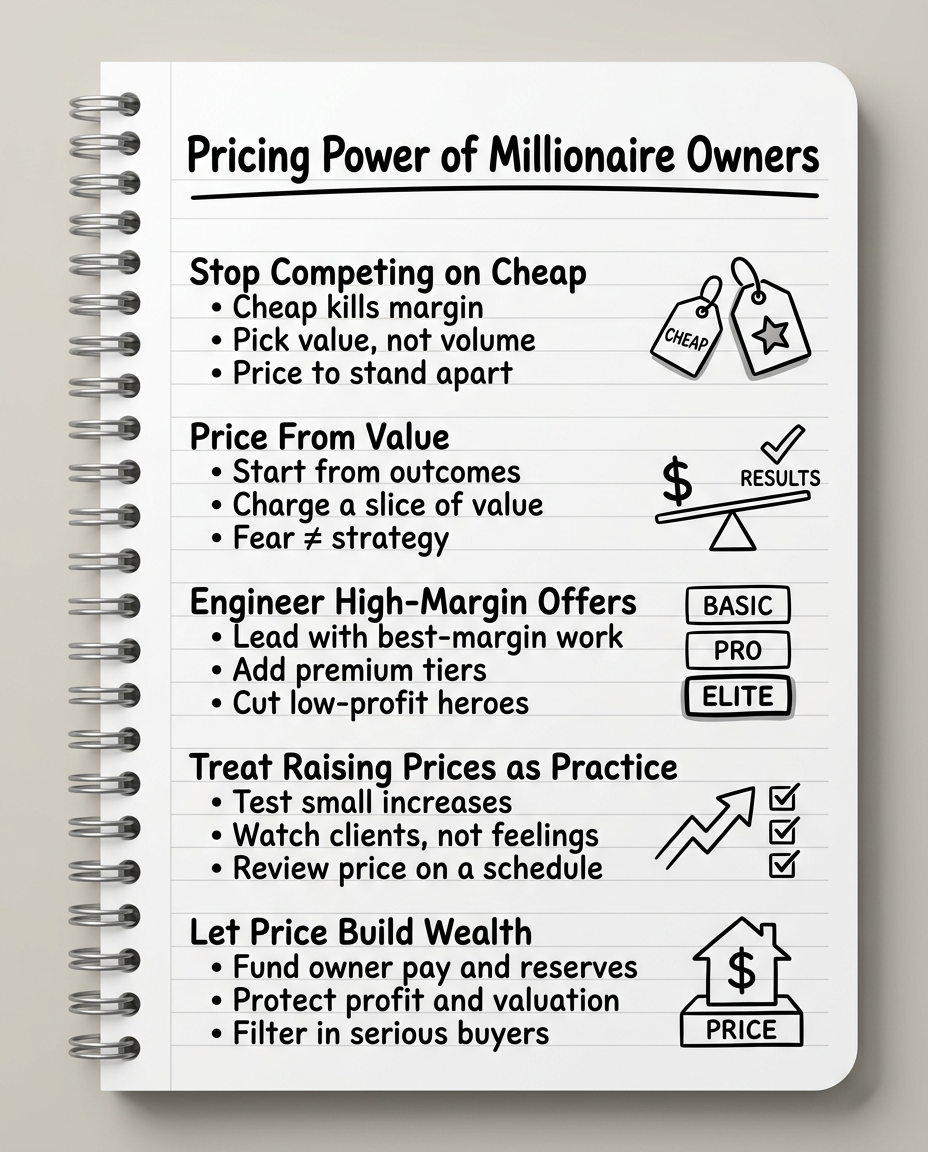
1. They Refuse to Compete on “Cheap”
Small operators love telling themselves, “My market is price sensitive.” What they really mean is, “I haven't built enough value or courage to charge what this is worth.”
There are only a few basic strategies:
- Be the low-price option — and live and die by volume and razor-thin margins.
- Be market parity — charging roughly what everyone else charges.
- Be high price, high value — where you get paid because you are clearly better and clearly different.
Millionaire owners almost never build their wealth on “I'm the cheapest.” They pick their lane — usually high value — and then build the product, experience, and proof that justifies it.
2. They Price From Value, Not From Fear
Most owners back into pricing from what feels “safe”:
Fear math:
- ✗ “What are others charging?”
- ✗ “What won't scare people away?”
- ✗ “What would I personally be willing to pay?”
Value math:
- ✓ What quantifiable outcome or pain relief do we create?
- ✓ What is that outcome worth in dollars, time, or risk removed?
- ✓ What share of that value is fair for us to keep?
Value-based and premium pricing are built on the customer's perceived value, not your insecurity. When you solve expensive problems, you are allowed — obligated — to charge like it.
3. They Engineer Offers for Margin, Not Just Revenue
If pricing is the front door, margin is what actually makes you rich. Anybody can discount their way to busyness. Wealthy owners design offers around high margin from day one.
They:
- Focus marketing around their highest-margin products or services.
- Use tiers and premium versions to capture more from buyers who want better, faster, or done-for-you.
- Ruthlessly cut or raise prices on “hero” services that impress people but barely make money.
The goal is simple: more dollars of profit per unit of effort. That is how you compress the timeline to seven figures.
4. They Practice Raising Prices Like a Skill
Pricing courage is not a personality trait. It's a trained behavior.
Millionaire operators:
- Test small, controlled increases with their least price-sensitive segments first.
- Watch what happens to close rates, client quality, and workload.
- Document wins (better clients, fewer headaches, more cash) so their nervous system recalibrates.
They know most owners set their prices once and then leave them to rot while costs, inflation, and demand change underneath them. Winners treat price reviews like a recurring board meeting agenda item.
5. They Use Pricing to Qualify, Not Just Charge
Your price is a filter. It tells people how seriously you take your work and what kind of relationship you're willing to have.
Low-end pricing:
- ✗ Attracts the most demanding, least respectful buyers.
- ✗ Fills your calendar with people who argue about every line item.
- ✗ Leaves no room for staff, systems, or your own owner pay.
Premium, value-aligned pricing:
- ✓ Signals that you solve real problems for serious people.
- ✓ Filters in buyers who are invested enough to do their part.
- ✓ Leaves room for you to hire, improve, and actually serve at a high level.
This is exactly how the people you study built empires: the price is part of the positioning.
6. They Tie Price to a Bigger Wealth Plan
Millionaire owners never look at price in isolation. They link it to:
- The owner pay they need to justify the grind.
- The profit margin needed to build a real reserve and invest back into the business.
- The long-term valuation of the company itself — because higher, defensible margin and pricing power increase what the business is worth when they eventually exit.
It's not “Can I charge this?” It's “What price supports the life, the reserves, and the valuation I'm building toward?”
The Shift: From “Can I Charge This?” to “What Does a Millionaire Charge Here?”
The difference between the average owner and the millionaire-in-training is not just confidence — it's a completely different pricing philosophy.
One group tiptoes around numbers, afraid to offend. The other designs value, positioning, and proof that make their prices feel inevitable — and then uses that pricing power to build margin, reserves, and, eventually, net worth.
Stop Guessing. Start Pricing With Clarity.
If you want to see which offers have the margin, which clients are actually worth serving, and what your price changes do to profit — that's exactly what CogniFlow Books exists to show you.
Start Free Trial7-day free trial · No accounting knowledge needed