There's a point where “working hard” stops mattering. The founders and families you study — Fortune 500 CEOs, Shark Tank killers, the Musks, Trumps, Goggins-level operators — are not winging it with vibes and a bank app. They run their business on a few non-negotiable numbers and punish everything that doesn't serve those numbers.
Most owners never make that shift. They stay stuck in “busy and guessing” instead of graduating into the level of clarity that actually builds seven- and eight-figure wealth. This is the owner math that changes that.
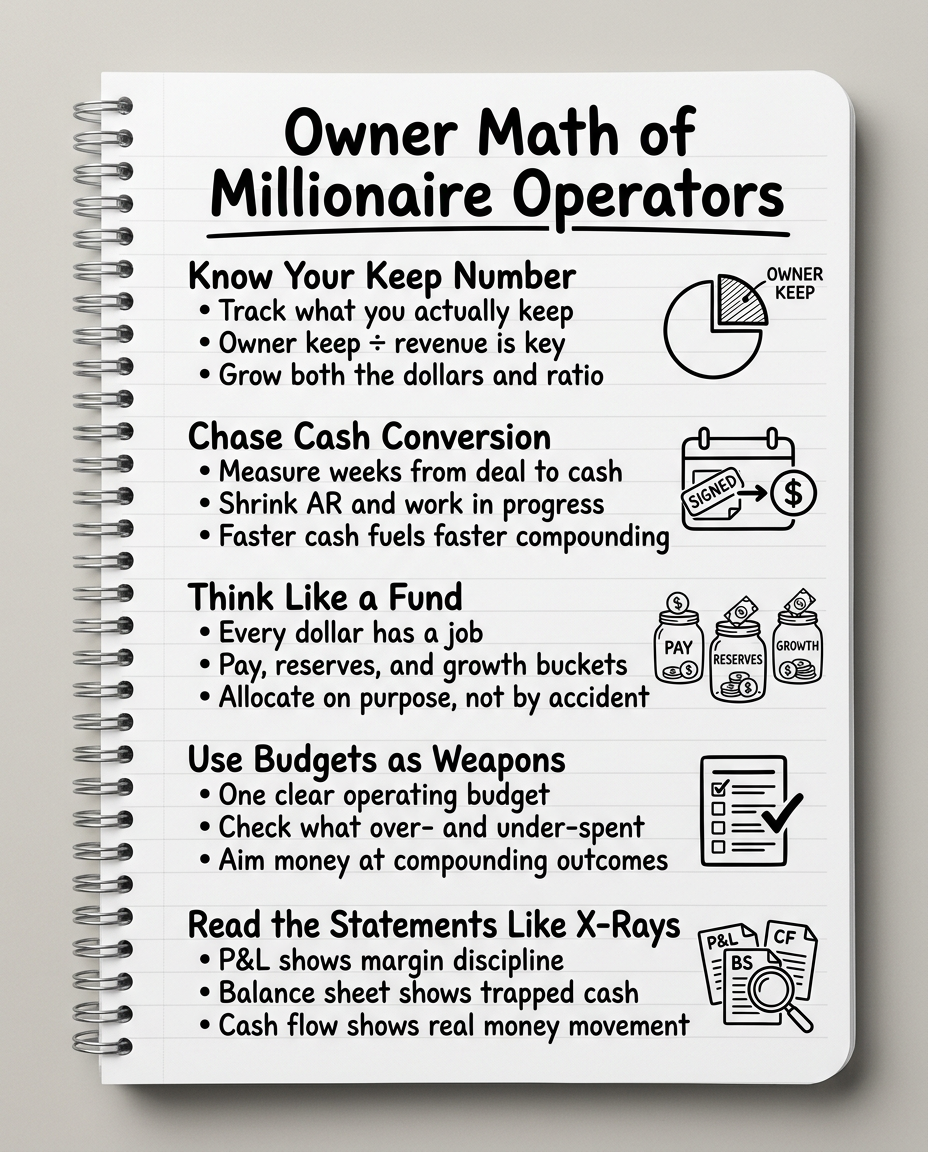
1. Millionaire Owners Always Know Their “Keep Number”
Employees talk about salary. Hustlers talk about revenue. Serious operators talk about what they keep — after taxes, after debt, after everything.
Normal owners:
- ✗ Can't tell you what they actually kept from last year in under 30 seconds.
- ✗ Confuse big top-line months with building wealth.
Millionaire owners:
- ✓ Know last year's true owner profit, not just business profit.
- ✓ Track a simple ratio: Owner Keep ÷ Revenue and aim to grow both the numerator and the ratio over time.
When that number is clear and trending up, you're no longer just “in business.” You're building a machine that feeds your life and your balance sheet.
2. They Obsess Over Cash Conversion, Not Just Sales Volume
You will never see Jensen Huang, Dana White, or a serious PE-backed CEO bragging about raw sales without knowing how fast those sales become cash. The elite play is cash conversion:
- How long between “we signed the deal” and “money is in the bank and free to use”?
- How much cash gets stuck in AR, inventory, and half-finished jobs?
Owners who stay small ignore this and call it “just timing.” Operators on their way to millions:
- Map their cash cycle in weeks and treat it like a race time to beat.
- Shorten it with deposits, progress billing, and better collection discipline until every new sale hits the bank faster and cleaner.
Shorter cash cycles mean they can reinvest faster. Faster reinvestment is how compounding gets violent.
3. They Run Their Business Like a Fund, Not a Paycheck
The wealthiest families in the world don't think like “income chasers.” They think like capital allocators. Every dollar has 3 possible jobs: protect, grow, or distribute.
Amateur owner math:
“Did I make enough to pay myself and cover expenses this month?”
Millionaire owner math:
What percentage of every dollar goes to:
- • Base owner pay (your lifestyle)
- • Reserves and risk (your war chest)
- • Growth bets (marketing, capacity, assets with upside)
They set those percentages on purpose. They don't wait to “see what's left” — they allocate like a family office. That's how you end up with seven-figure net worth from seemingly normal income streams.
4. They Use Budgets as Weapons, Not Guilt Trips
A lot of founders treat budgets like diets: restrictive, temporary, and annoying. The people you admire treat budgets like fighters treat training programs — it's how they win.
Weak owner math:
- ✗ “We kind of know what we spend.”
- ✗ “We just cut stuff when things feel tight.”
Strong owner math:
- ✓ One clear operating budget: “this is how much it costs to run this machine on purpose.”
- ✓ Line-of-sight on which categories actually move profit and which are ego, fear, or drift.
- ✓ Monthly variance check: “Where did we overshoot, where did we underspend, and what does that tell us?”
Budgeting at this level isn't about restriction. It's about making sure the maximum amount of your money is pointed at outcomes that compound.
5. They Learn to Read the Statements Like a Second Language
Goggins reads pain — these owners read numbers. Income statement, balance sheet, cash-flow statement — they're not paperwork, they're x-rays.
Most owners:
- ✗ Glance at a P&L when the accountant sends it.
- ✗ Never look at the balance sheet.
- ✗ Treat the cash-flow statement like hieroglyphics.
Millionaire operators:
- ✓ Use the income statement to track margin and operating discipline.
- ✓ Use the balance sheet to see where cash is trapped or risk is building.
- ✓ Use the cash-flow statement to understand how decisions showed up in actual money movement.
They don't delegate understanding. They delegate data prep. The literacy is non-negotiable.
6. They Turn Financial Literacy Into Strategy, Not Trivia
You don't get points for knowing terms. You get points for moving money differently.
The leaders you study — Jobs, Musk, Altman, Cardone, the Sharks, Google-level execs — use financial literacy to:
- Decide what business models they will never touch.
- Spot which products or clients are secretly unprofitable.
- Choose when to press the gas and when to hoard cash.
You can do the same on your scale:
- Use your numbers to kill work that doesn't earn its keep.
- Double down on the 20% of offers or clients that generate most of the free cash.
- Align your daily decisions with the “keep number” you set at the top.
This is how financial literacy stops being theory and starts being a weapon.
The Shift: From “I Hope This Works” to “I Know What I'm Building”
The biggest difference between the average business owner and the millionaire-in-training is not talent or luck. It's that the second group refuses to operate in a fog.
They can tell you what they keep, how fast cash converts, how the machine is budgeted, what the statements say, and what that means for their next move. That clarity is what makes risk tolerable and growth repeatable.
Run Your Business Like the Operators You Study
CogniFlow Books pulls all of that owner math out of scattered spreadsheets and bank apps into one clear, simple dashboard — so you can operate on purpose, with discipline, toward real wealth.
Start Free Trial7-day free trial · No accounting knowledge needed