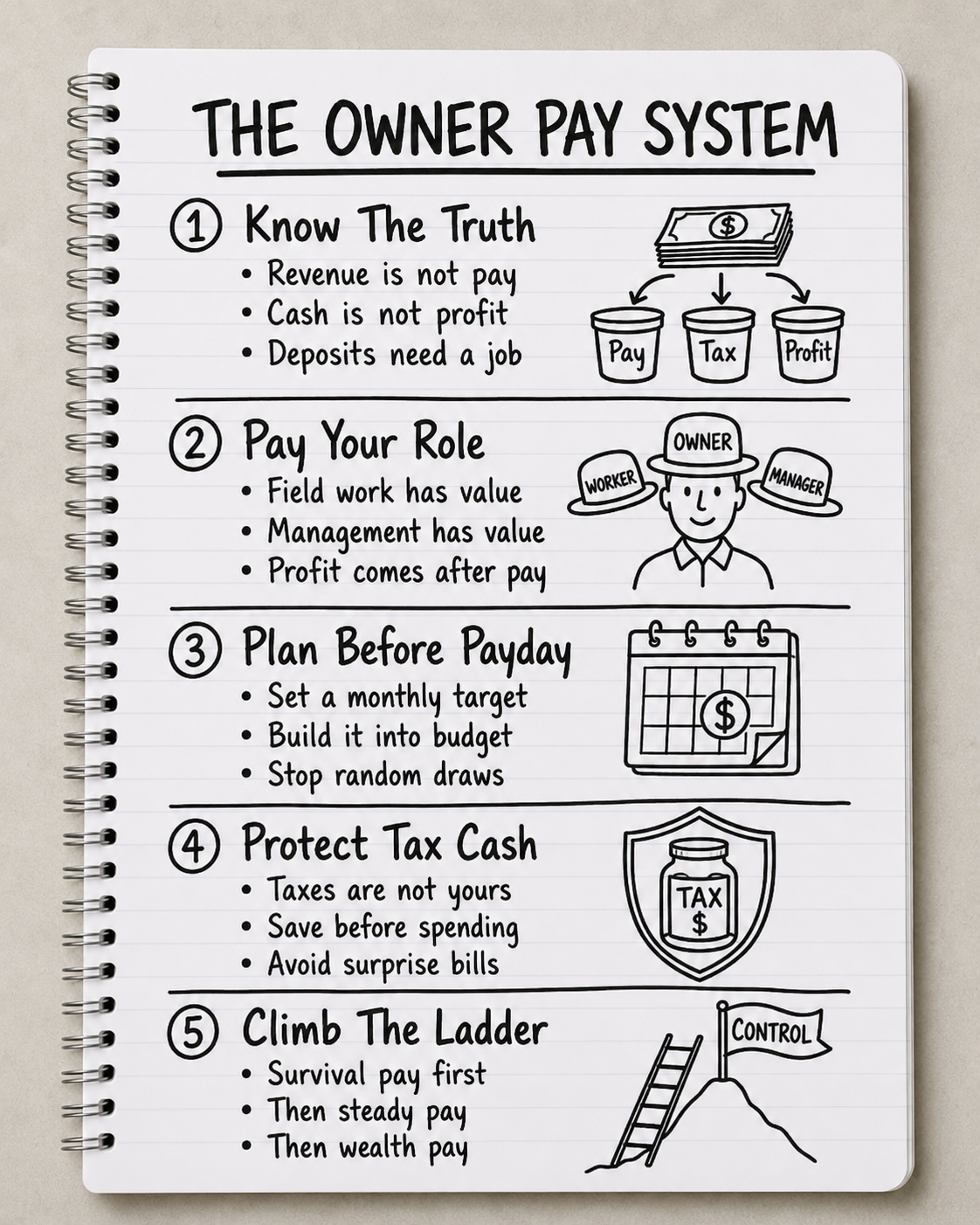
Most service business owners do not have a pay system.
They have a hope system.
They work hard. They sell jobs. They collect money. They pay bills. They pay workers. They buy fuel, tools, software, ads, supplies, and parts. Then they look at the bank account and ask one painful question:
“Can I pay myself this week?”
That is not ownership.
That is survival.
A real business should pay the owner on purpose. Not by accident. Not only when the month is good. Not only when customers pay fast. Not only when there is money left after everyone else gets paid.
Average owners:
Treat their own pay like an afterthought.
Millionaire operators:
Treat owner pay like a line item, a system, and a wealth plan.
This is one of the biggest gaps between a busy owner and a serious operator. A busy owner is always moving money around. A serious operator already knows what the business can afford, what the owner should be paid, what profit must stay in the company, and what cash must be protected.
Owner pay is not just about taking money out.
Owner pay shows whether your business model works.
If your company cannot pay the workers, cover overhead, pay taxes, build cash reserves, produce profit, and pay you a real wage, the business is not healthy yet. That does not mean you failed. It means the numbers are telling the truth.
Clean books show what the business is really making, what it is spending, what it owes, and what it can safely pay the owner. Without clean numbers, owner pay becomes a guess. And guessing is expensive.
1. Average Owners Confuse Revenue With Pay
Average owners see money come in and think they made money.
A customer pays $8,000. The owner feels rich. Then reality shows up.
Materials were $2,200. Labor was $2,000. Subcontractors were $900. Fuel, dump fees, software, insurance, and admin costs eat more of it. Taxes are still coming. The credit card has a balance. Payroll is due Friday.
That $8,000 was not owner pay. It was business money.
This mistake hurts a lot of service companies because cash moves fast. Money comes in big chunks, but bills come in from every side. If the owner does not separate revenue, cost, profit, taxes, and pay, the bank account becomes a trap.
The trap works like this. The owner lands a good job. The account balance goes up. The owner takes money out. Then expenses hit. Now the business feels short again. The owner sells another job to cover the last job. This keeps going until the owner is working harder but still not building wealth.
That is not a sales problem. That is a control problem.
Millionaire operators do not treat deposits like income. They treat deposits like raw material. The money must be sorted before it is touched.
They ask better questions:
- What did this job really cost?
- What gross profit did we make?
- What overhead does this sale need to cover?
- What tax money must be saved?
- What profit stays in the business?
- What can the owner safely take?
The operator mindset
Revenue is not the prize. Profit is the prize. Cash control is the prize. Owner pay is the prize only after the business model works.
Every time money comes in, it should be assigned a job. Some money belongs to labor. Some belongs to materials. Some belongs to overhead. Some belongs to taxes. Some belongs to profit. Some belongs to owner pay.
When money is sorted this way, the owner stops asking, “How much is in the account?” The better question becomes, “How much is actually available to pay me?” Those are not the same question.
Average owners ask the bank account for permission. Millionaire operators build a pay system the business can support.
2. Your Business Must Pay You for Your Role
A lot of owners do not know what they should be paid because they play too many roles. They sell. They manage jobs. They do the work. They answer calls. They order supplies. They handle complaints. They make schedules. They collect payments. They run payroll. They fix mistakes.
Then they say, “I paid myself $70,000 this year.”
But that number may not mean what they think it means. Were they paid as a worker? A manager? The owner? A return on risk? For profit?
Those are different things.
This matters because a business can look profitable only because the owner is working for free. That is one of the most common lies in small business. The books say there is profit. But the owner worked 70 hours a week and did not pay themselves a fair wage for the work they performed. That is not real profit. That is unpaid labor.
Here is a simple example. An owner does field work all week but does not count their own labor in job costs. The job looks profitable because the owner's time was treated like free labor. Then the owner hires someone to replace that work and suddenly the job loses money. Why? Because the job was never priced right. The owner was hiding the true cost with their own unpaid time.
Millionaire operators do not build companies on hidden labor. They price the work as if the business had to pay someone else to do it.
- If the owner works in the field, the business should understand the market cost of that labor.
- If the owner manages operations, the business should understand the value of that management role.
- If the owner sells, the business should know what sales labor would cost.
- If the owner owns the company, the business should still produce profit above fair pay for work.
Owner pay for work is not the same as profit. Profit is what is left after the business pays fair costs, including fair labor.
You do not want a business that only pays you when you work in it. You want a business that can pay you for your work now and build profit that grows your wealth later.
Start by writing down every job you perform in the company. Group them into buckets: field work, sales, admin, operations, management, owner decisions. Then ask, “What would I have to pay someone else to do this?”
This does not mean the business can pay all of that right away. But it gives you the truth. It shows the gap between where the business is and where it needs to be. It also helps you plan your next hire.
The goal is not just to make the owner busy. The goal is to make the owner paid.
3. Owner Pay Must Be Planned Before the Money Comes In
Average owners:
Pay themselves after the month happens.
Millionaire operators:
Plan owner pay before the month starts.
When owner pay is not planned, the owner becomes the shock absorber for the whole business. If a customer pays late, the owner does not get paid. If a truck breaks, the owner does not get paid. If payroll runs high, the owner does not get paid. If a job goes bad, the owner does not get paid.
The owner carries every mistake. That may feel noble. But it is dangerous. A business that only survives because the owner goes unpaid is not stable.
Planning owner pay forces the business to face reality. It tells you how much sales volume you need. It tells you what margin you need. It tells you what overhead you can afford. It tells you when pricing is too low. It tells you when payroll is too heavy. It tells you when the owner is still funding the company with unpaid work.
A simple monthly owner pay plan starts with a target:
- How much does the owner need to live? (survival)
- How much should the owner be paid for the role they perform? (fair pay)
- How much should the owner take as profit when the company performs well? (wealth)
Average owners stop at survival. Millionaire operators build toward fair pay and wealth.
Once you set a target, build it into the monthly budget. Owner pay should sit beside payroll, rent, insurance, software, taxes, vehicles, and debt payments. It should not sit in the leftover pile.
If the business cannot support the target, do not ignore the truth. Fix the model:
- Raise prices
- Cut waste
- Improve scheduling
- Speed up collections
- Reduce bad jobs
- Improve sales close rate
- Stop discounting
- Track job costs
- Clean up overhead
This is how owner pay becomes a management tool. It shows you where the company is weak. A lot of owners avoid this because they fear the answer. They would rather not know. But not knowing does not protect you. Not knowing keeps you trapped.
Without a plan, the owner may take too much after a good week, and the company gets tight. Or the owner may take too little for too long and build anger toward the business. Both are bad. A planned pay system creates peace — it gives the owner a rhythm and the company a target.
4. Do Not Steal From Taxes to Pay Yourself
One of the fastest ways to create stress is to spend tax money like it belongs to you.
It does not.
Average owners often mix tax money with operating cash. They see a healthy bank balance and think the business is safe. But hidden inside that balance may be payroll taxes, sales tax, income tax, or money needed for future tax payments. Then tax time comes and the owner panics — pulling from savings, using a credit card, delaying a vendor, skipping their own pay, or taking on bad jobs just to raise cash.
Tax money must be protected before owner pay is taken.
Average owners:
Treat taxes like a future problem.
Millionaire operators:
Treat taxes like a current cost.
When money comes in, a piece should be set aside for taxes based on your tax plan and your professional advice. That money should not be treated as spending money. It should not be used for tools, ads, meals, owner draws, or payroll gaps. It is not yours.
The problem is that many owners only look at cash. They do not look at profit. They do not know what they may owe. They wait until the tax preparer tells them the bill. By then, it may be too late to plan.
Clean books give you an early warning. When your books are current, you can see profit trends, talk to your tax professional before the year ends, and set aside money with more confidence.
Owner pay should work with the tax plan, not against it. This is also where business structure matters — some owners take draws, some take payroll, some take both. The right setup depends on your business type, tax structure, state rules, and advice from a qualified tax professional. The main point is simple: do not guess, do not take money out just because the account looks full, and do not be surprised by a tax bill you could have planned for.
Surprise is expensive. Control is cheaper.
5. The Owner Pay Ladder
Owner pay should grow as the business gets stronger. Average owners want to jump straight to big pay before the company can support it. Millionaire operators build a ladder.
A ladder gives you stages. Each stage has a purpose. You do not skip steps. You climb as the business earns the right.
Survival Pay
The minimum amount the owner needs to keep their personal life stable. It may not be the dream number, and it may not be fair for the hours worked — but it keeps the owner from drowning while the business gets stronger.
Steady Base Pay
A planned amount paid on a normal schedule — weekly, twice a month, or monthly. The key is that it is planned. The owner is no longer taking random draws based on fear or excitement.
Market Pay for the Role
The owner is paid closer to what the business would pay someone else to do the same work. If the owner is the general manager, pay should move toward general manager value.
Profit Pay
Money the owner takes because the business produced real profit after expenses, taxes, reserves, and fair pay. This is where the owner starts to feel the reward of building a real company.
Wealth Pay
The company can fund owner income, profit distributions, reserves, debt reduction, investments, and growth without living on the edge. The owner is no longer buying a job — the owner is building an asset.
The ladder also gives the business rules. Do not move to profit pay if taxes are not protected. Do not increase base pay if payroll is late. Do not take wealth pay if the business has no cash reserve. Do not reward yourself for revenue if the jobs had weak margins.
This may sound strict. It should be. Money without rules disappears.
The ladder also helps with emotions. Owners often underpay themselves out of guilt, treating every dollar like it should go back into the business. That can be good for a season, but if the owner never gets paid, they burn out. Others overpay themselves out of entitlement — taking money whenever they want — which can starve the business and create late bills, weak reserves, tax stress, and payroll fear.
Both problems come from the same place: no system.
The ladder gives you a system. You know where you are. You know the next step. You know what must be true before you climb.
You cannot climb the pay ladder based on vibes. You need current books, clear reports, and a real view of cash flow.
6. Your Prices Must Include Owner Pay
Many owners are underpaid because their prices were never built to pay them. They price based on fear. They worry the customer will say no. They copy competitors. They guess labor. They forget overhead. They ignore admin time. They do not include profit. They do not include owner pay. Then they wonder why the business feels heavy.
If owner pay is not in the price, the owner will pay for it later — with stress, late nights, missed family time, debt, and burnout.
Average owners:
Price to win the job.
Millionaire operators:
Price to win the right job.
Winning a bad job is not winning. A bad job keeps the crew busy but leaves no money. A bad job makes the owner feel like sales are up while the company is still broke.
Your full pricing structure must support the real cost of running the company: direct labor, materials, subcontractors, equipment, vehicles, insurance, software, admin, marketing, management, taxes, profit, and owner pay. If the price does not cover these things over time, the business model is weak.
Many owners think they have a pay problem. They really have a pricing problem. They are trying to pull owner pay from jobs that were never priced to create it.
This is why job costing matters. After each job, compare what you expected to what happened:
- Did labor run high?
- Did materials cost more?
- Did the crew lose time?
- Did the customer add changes — and did you charge for them?
- Did overhead get covered?
- Was there real gross profit?
- Did the job help fund owner pay?
This habit makes you smarter fast. You stop guessing and start seeing patterns. Maybe certain job types are weak. Maybe your minimum service call is too low. Maybe your close rate is high because your price is too cheap.
The millionaire operator does not ask, “What is the lowest price I can charge and still get the job?”
They ask, “What price lets us serve the customer well, pay the team, cover the company, protect cash, produce profit, and pay the owner?”
Ask it often.
7. Owner Pay Needs Rules, Not Moods
Money gets messy when decisions are based on mood.
Good week? Take extra. Bad week? Take nothing. Big deposit? Buy something. Slow month? Panic.
This is how average owners live. Millionaire operators use rules. Rules remove drama.
A simple owner pay rulebook:
Some clear guardrails:
- Do not take extra owner pay if taxes are not funded.
- Do not take extra owner pay if payroll is at risk.
- Do not take extra owner pay if vendor bills are late.
- Do not take extra owner pay from customer deposits needed to finish work.
- Do not raise base pay until the company can support it for several months.
- Do take planned pay when the business meets the rules.
- Do review pricing if owner pay is always short.
- Do protect profit when jobs perform well.
- Do build cash reserves before lifestyle upgrades.
Rules like these create trust. The owner trusts the business more. The team trusts payroll. Vendors get paid. Taxes get handled. The household gets more stable. The company grows from a stronger base.
This is what financial control looks like in real life. It is not fancy. It is not complex. It is about knowing what money is for before you spend it.
Clean books are not just for tax time. They are for owner control. They tell the owner when to hold back. They tell the owner when to fix prices. They tell the owner when the business can afford more pay. They tell the owner when the business is ready for the next stage.
The goal is not to take the most money possible today. The goal is to build a company that can pay you for years.
Owner Pay Is a Sign of Business Health
If you only pay yourself from leftovers, you do not have a pay system. You have a stress cycle. If your company cannot pay you, pay taxes, cover payroll, protect cash, and create profit, the numbers are telling you to fix the model.
Average owners chase deposits. Millionaire operators build pay systems. They know their role. They know their numbers. They plan owner pay before the month starts. They protect tax money. They price work to include profit. They use rules instead of moods.
Build Financial Control. Pay Yourself With Confidence.
CogniFlow Books helps service business owners build financial control with clean bookkeeping and clear numbers. When you can see the truth, you can pay yourself with confidence and build a company that supports your life instead of draining it.
Start Free Trial7-day free trial · No accounting knowledge needed